
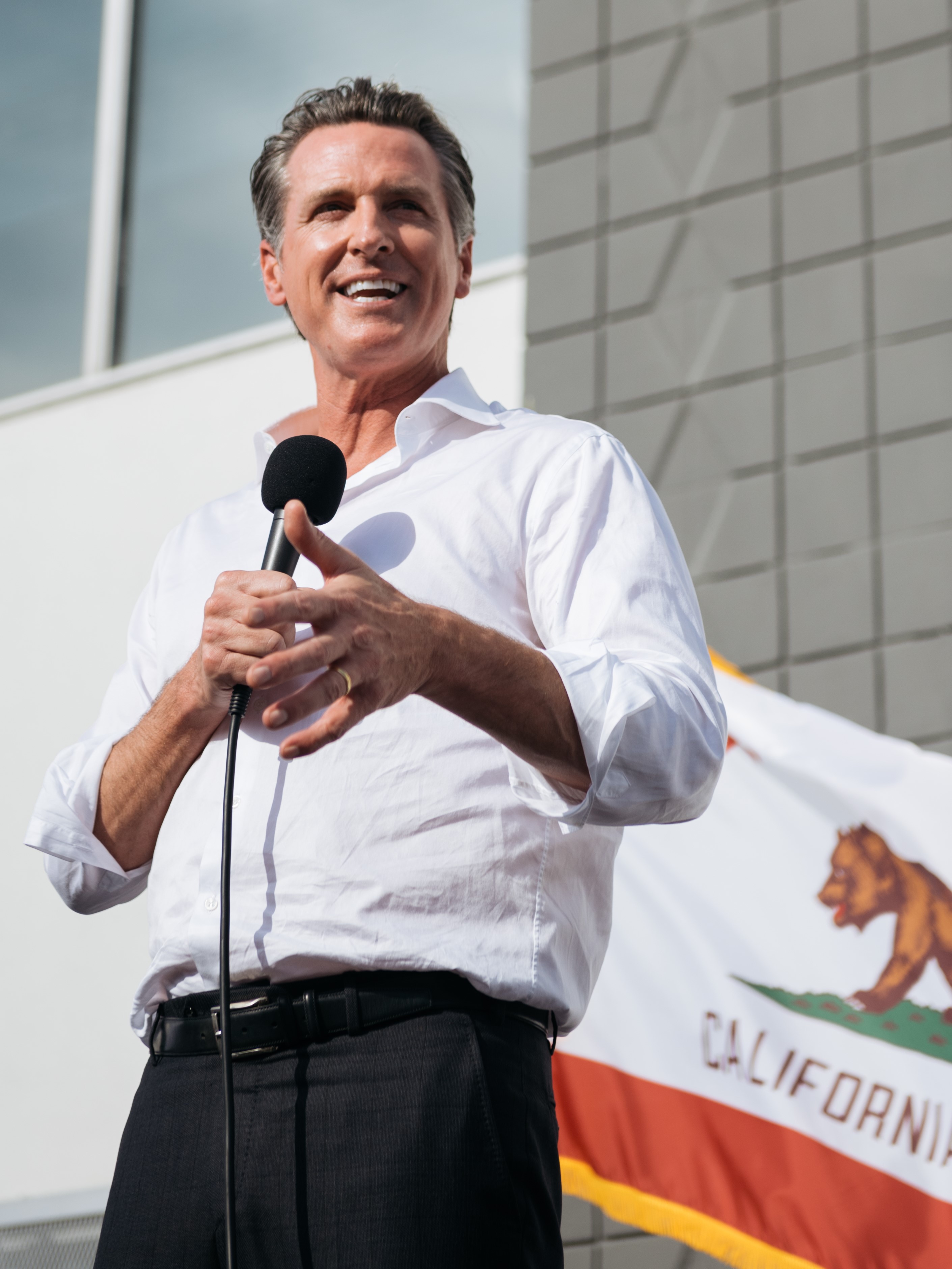
Gov. Schwarzenegger's Budget: May Revision
   
Live Announcement
GOVERNOR:  Thank you very much.  Thank you.  Good afternoon, everybody.  As you know, today I'm presenting to the Legislature my May Revision of my Budget Proposal of fiscal year 2007-2008. 

But before I begin and talk about the budget, I would like to just say a big, big thank you to our great, great Finance Director Mike Genest and his entire team.  I want to thank him very much for the hard work.  Just as every year, Mike and his staff have been working around the clock seven days a week to bring those numbers in on time.  So I would like the entire team to stand up, and let's give them a big hand for the great work that they have done.  (Applause)

I also want to say thank you very much to our Cabinet Secretaries that are over here.  I want to thank them for being here today, and also for their hard work, because they also made it happen, that we have this great budget.  I also want to thank Susan Kennedy, my Chief of Staff, for her great work, because without her I couldn't do that, so thank you very much.  Let's give her also a big hand.  (Applause)

And I also want to thank the Legislative Leaders that are here today; Speaker Núñez, Senator Perata, Senator Ackerman -- and there a bunch of other legislators here today, I can't quite see with the lights.  But thank you very much, all of you, for being here.  There are a lot of Democrats, I like that. 

But anyway, as you all know, California's economy continues to be very sound.  We have created thousands of new jobs; as a matter of fact, in March we created 18,500 new jobs, unemployment is as low as it has been in three decades, and growth in personal income remains very healthy.  And even though we had a slump in the housing market -- both nationally and also here in California -- and for a while we didn't think that we were going to make the numbers, our revenue projections have come out right on target.  In my January Budget Proposal we projected General Fund revenue of 101.3 billion dollars for the coming fiscal year, and that's exactly where we are in our May Revise.  And we have a budget that is fiscally responsible, fully funds education, continues to pay down our debt, and leaves California with a prudent reserve of 2.2 billion dollars.  And for the fourth year in a row, we are not raising taxes. 

We have made tremendous progress.  As you remember, when I took office, our structural deficit was estimated at 16.5 billion dollars, and every year we brought it down, and we brought it down.  And now we've brought it all the way down to 1.4 billion dollars, and we did it by growing our economy and exercising spending restraint.  Our spending growth, for instance, is 1.5 percent over the current budget year, which is certainly a very conservative increase.  So you can see that we have been very careful, and very responsible, even as we managed to invest in California's future and tackle big problems like infrastructure and prison reform. 

While others have called for us to reduce funding for education, kindergarten through 12th, my budget fully funds Proposition 98 to the tune of 57.6 billion dollars, up from 55.4 billion dollars in the current year.  That's an increase of 2.2 billion dollars.  Since I took office, our annual education budget is up by 11.5 billion dollars.  That is an increase of 21 percent, and the total per pupil funding is up to 11,562 dollars.  My budget also fully funds our compacts with higher education for an investment of 346 million dollars. 

It fully funds also our compacts with our state court system, and we are providing 610 million dollars for local law enforcement.  We are also fully funding our Healthy Family Program, which by the end of the budget year will be over 920,000 children.  That is an increase of 148,000 children over the last 2 years, a direct result of our increased outreach efforts. 

There are also some changes that have happened in our budget since the January budget, and we have been faced with some additional expenditures that we had no control over, and that required us to take some additional steps to make sure that we still have an adequate reserve.  For instance:
  • Proposition 98 required an additional 809 million dollars to fund kindergarten through 12th and community colleges;
  • To continue upgrading our prison health care, as required by the Federal Receiver, we added 25 million dollars to the already 150 million dollars that were in the January budget;
  • We have also experienced an increase in our Health and Human Services caseload that is driven by existing law and eligibility rules;
  • And we approved a managed care rate increase by 214 million dollars to maintain access to billions of dollars in federal funds. 
But California's budget still lives on the razor's edge.  When there is an economic slowdown, we usually have three choices; we increase taxes, or we make deep cuts, or both.  In California today our choices are even more limited, because more than 90 percent of the budget is already spoken for under existing laws and spending formulas.  So reductions usually come from the discretionary funds, the 8 percent of discretionary funds, and that usually comes from Health and Human Services, or law enforcement, or transportation. 

And although we make some tough decisions in this budget, we did everything in our power to avoid taking that path.  Instead, we got creative.  We focused on ways to expand revenues and to think a little bit outside the box.  My budget, for instance, proposes selling California's EDFUND, a state-created entity that guarantees student loans to banks and other financial institutions.  EDFUND does not set loan rates and it doesn't provide loans to students, so students will not be impacted.  And we are confident enough about its value in the open market to include nearly 1 billion dollars in our general fund. 

Now I want to talk a little bit about the California Lottery.  Although it's not reflected in this budget -- and I repeat, it's not reflected in this budget -- we are exploring whether we can dramatically increase the benefits to taxpayers from the lottery by developing a public-private partnership to manage the program.  Our lottery is a very valuable public asset, but it does not perform nearly as well as in other states.  We can double or triple the revenues from the lottery if we maintain ownership, but lease it to the private sector to manage the sales.  We know our lottery has tremendous market value, some say all the way up to 37 billion dollars and more. 

Imagine what we could do with this kind of resources.  Let me put it in perspective, how leasing the lottery could be a boon to our bottom line.  You all remember when I took office we had to sell 11 billion dollars in economic recovery bonds because California was going broke, and we had to stop the bleeding.  To jumpstart the economy was really working very well; as a matter of fact, this is why our economy has returned and is doing so well today.  But we still have 8 billion dollars left to pay before those bonds are completely retired. 

The budget that I am proposing today has 3.1 billion dollars in debt services on those bonds, and it all comes out of the general fund.  In 2008 and 2009 budget we will be doing the same thing again.  Now, think how great it would be if we could just pay off those bonds once and for all.  That would generate billions of dollars in revenues for our budget, and it would definitely help our structural deficit.  And if we do go down this road, of course the existing fund for schools that comes from the lottery will be protected, and I repeat, lottery funds for schools will always be protected. 

In addition to the investments that I already mentioned, our budget takes a number of other very positive steps to protect California's priorities to keep our state safe and very strong.  For instance:
  • 178 million dollars from our November Transportation Bond will improve security and anti-terrorism efforts at our ports and mass transit systems. 
  • We're also putting an additional 4.5 million dollars into local food banks, and also an organization that helps store and deliver food during emergencies, like last winter's freeze. 
  • The Air Resources Board will spend 111 million dollars in bond funds to improve air quality in California's major trade corridors. 
  • And this budget maintains also and commits to paying down the 1.6 billion dollars by its early payment of our Economic Recovery Bonds.  This repayment is important to our fiscal health because it uses funds for one-time needs, not for ongoing programs, and it keeps our credit rating strong, which saves taxpayers a lot of money.
So once again, I'm very excited about what we have achieved here as we continue to get our fiscal house in order and to prepare for the future.  We have sound and creative new ways to increase our revenues and give taxpayers more value for the hard work that they have done in building California's 1.7 trillion dollar economy, and that is without raising taxes and without making deep cuts to important programs. 

I look forward to working with the Legislators, Democrats and Republicans alike, to keep making good choices and more smart investments, and to find ways to get rid of our structural deficit once and for all.  Thank you very much. 

And now, if you have any questions, please feel free. 

Q:  Governor, I have a quick question.  You were talking about --

GOVERNOR:  Where are you?

Q:  Over here, sorry.  You were talking about the early payment of those Economic Recovery Bonds, and there have been some critics, the Legislative Analyst's Office and some members of the Legislature, who wonder why you would prepay some of that when there are still services and things that Californians need.  I think the analogy that was used earlier this year is, why make an extra mortgage payment when you can't pay your utility bill? 

GOVERNOR:  Well, I think that it is very simple.  We have to make sure that we cut down our structural deficit, and we have to make sure not to make the same mistake again as we have made in early 2000, where we took revenues that increased, and increased, and increased, and always assumed that those revenues will always be there, and so we never really were prepared for that downfall that we had in the early 2000s.  We don't want to make those mistakes again.  I think the Legislative leaders have talked about that, we all have talked about it, that we don't want to do the same thing again.  We want to be fiscally conservative in this area, and we want to cut down the structural deficit. 

Yes, please.

Q:  Part of your budget eliminates the Williamson Act, which many people in the agricultural regions rely on, and have done so for years.  What's the rational behind eliminating that?

GOVERNOR:  Well, again, you will find that we have tried to bring down the structural deficit and to be fiscally responsible.  And so we looked at various different areas, and that was one of the areas that we took out, because it was 40 million dollars, and we thought that we can use that money for better use. 

Q:  Governor?

GOVERNOR:  Yes, please.

Q:  The Controller announced recently that the actuaries are now estimating the State has a 48 billion dollar unfunded liability for retiree health.  What's your view?  At some point, should the State start setting aside money for that?  How do you plan to deal with that?

GOVERNOR:  Absolutely.  First of all, this is one of the big things that have been pushed under the rug, swept under the rug, for many, many years, as you know.  And I think that for me it is very important that I think that I was elected and sent to Sacramento to take on all of those big challenges -- if it is infrastructure and rebuilding California, if it is taking on our prison reform, which has been a problem for many, many years, if it is health care reform -- all of those things we want to take on and we want to fix, including also, of course, our unfunded liabilities.  I think that's why we put together a commission.  I think Democrat and Republican Legislative Leaders have all appointed people to that commission, and they are looking into that.  Not only looking into it and studying it, because we know already what the problem is, but to find ways of how to solve that problem.  So by the end of this year this commission is going to come back and is going to give us tough recommendations.  We want to have exactly the facts.  What do we need to do to fund this, and what is the right way to go about it? 

Yes, please.

Q:  In January you proposed a little over 3 billion dollars of so-called solutions, including transfer of mass transit funds, suspension of welfare COLAs and so forth.  You've added to that another 2 billion dollars, including the sale of EDFUND, including suspending COLAs for SSI, SSB, and a variety of other things.  These are all -- have not been greeted well; at least the initial group of them was not greeted well in the Legislature.  You potentially have about 5 billion dollars here of things out there hanging on the limb that may or not be approved.  What's your confidence level that the Legislature is going to go along with this 5 billion dollars worth of solutions, so called?

GOVERNOR:  Well, I think that I want to have them included in these discussions.  I think that it is very important, when we look for increased revenues, that we don't look at increasing taxes.  There are so many other ways where we can go and increase revenues, if it is stimulating the economy, or for instance through the EDFUND that we talked about, or the lottery, to hold onto the lottery and keep ownership, but to go and lease it out, or to let someone take over the sales.  I think there is so much money there available, so I think the Legislative Leaders and the legislators and everyone in the Capitol has to look at that and just say, you know, "Well, there is a great opportunity there for us."  We could take a chunk, for instance, of the lottery money, of those billions and billions of dollars, we can take that and start paying down some of these unfunded liabilities that we have.  Or we can go and use it for other purposes where we need it for programs and so on. 

So there are many different ways of going, so we have to just think outside the box and not always think the same way.  So what I am doing is, I am proposing those things, totally with the understanding that the legislators are my partners, and that we all make those decisions together -- and not only the Legislative Leaders and legislators, but also the stakeholders that are involved, if it is the CTA and others that are involved in those kind of decision makings.  So we want to work together with everyone. 

But I think that's the direction to go, because the fact of the matter is that there's a lot of money out there in the private sector.  We have to recognize the fact that the private sector has more money than the public sector now, and they're all looking for investments, and they're all offering a lot of money.  Let us go and get involved in public-private partnerships.  It's the great way of the future.

Q:  What about suspending the COLAs, the welfare recipients and the older disabled people?  Do you think that's something that's going to fly in this Capitol?

GOVERNOR:  I'm not happy about doing it.  I wish that we could fund all of those programs, let me tell you.  I think that a lot of people deserve this money, but I have an obligation, which is I promised the people of California that I will bring down the structural deficit to zero, and that we will be fiscally responsible.  So there are two choices.  One is to create extra revenues through all the various different means that I have proposed, or the other one is to go and start making those cuts.  Yes?

Q:  You touched on this, but how does privatizing the operation of the lottery help you to sell your spending cuts this year?  What's your expectation?

GOVERNOR:  Nothing.  It has nothing to do with this here.  Like I said, the lottery idea has nothing to do with fiscal year 2007-2008.  This is something that could take a long time to negotiate, I have no idea.  But it is a great idea, when you think about the kind of money that other states are making.  Massachusetts has one-fifth of the population of California, and they're making one-third more money with the lottery.  So it just shows to you the efficiency level, and how well other states are doing, and we are making 1.3 or 1.4 billion dollars, and 1.1 goes to education.  I think we can do much better, and I think that we can therefore afford many more things, and pay off our debt.

Yes, please.

Q:  The Legislative Counsel Opinion that indicates that privatizing the lottery would be unconstitutional without a vote of the people, is that what you intend to seek?

GOVERNOR:  Well, I see it that it can be done with two-thirds of the vote.  But you know, I'm not a legal expert.  So if they decide that we need to have the people vote on it, I think that's easy, we just put it on the ballot and let the people decide if they want to have this extra money that goes towards education and all kinds of other programs, and pay off our unfunded liabilities and so on.  So I think the people will go for it.  I'm not worried about that at all. 

I think the key thing is here that we've got to find new ways of creating the revenues.  And I think that the state has done an extraordinary job. and if you'd just put up that slide again of how we decreased the structural deficit -- I think this is something that we all can be very proud of.  We started out with 16.5 billion dollars, and then we came all the way down.  Every year we cut down, and we cut down, and now we are down to 1.4 billion dollars -- to be exact, 1.39 billion dollars.  That's what we have to do.  We have to continue going down in that direction in order to be fiscally responsible.  We owe this to the people of California. 

Q:  Governor, in January's budget --

GOVERNOR:  Yes?

Q:  In January you said that the net deficit could be brought down to zero this year; now we're back at 1.4 billion.  What do you blame that on?  And it seems like the California lottery deal becomes more critical to bringing that down to zero.

GOVERNOR:  Well, as I have said in my speech, that there were some unforeseen things, as in every budget.  That's why you have a January budget, that's why you then have a May Revise, because you know that you always have to revise the budget, because there are unforeseen things that happen.  And you know something?  The things that happen -- like for instance the 800 plus million dollars for education, kindergarten through 12th grade -- I'm proud that we're giving education 800 million dollars more. 

But the fact of the matter is, that's what changes then the May Revise.  You know, then all of a sudden you see yourself that it is more than a billion dollars, that you have paid out more than you anticipated.  And then you have, of course, the prison situation, where we had to put extra money in to the additional 150 million dollars that were already in the January budget, another 25 million dollars. and then 214 million dollars in Health and Human Services.  So there are all kinds of areas that you don't anticipate, but that is why it is very important that we have a prudent reserve, and that's why the 2.2 billion dollars is very important, because there will be other unexpected things that will come up.  Any other questions?

Yes?  Hold on, there's  a mike right there.  Please.

Q:  Do you have a proposed buyer for EDFUND?  And is there anything you can put in it to guarantee that students are protected?

GOVERNOR:  No, that will be going out and people will make bids.  And yes, it is extremely important, whatever we do, that the students are always 100 percent protected.  That is extremely important.  This is why in this particular case they will not go and give loans or make decisions on the loan rates or anything like that.  This is just a loan guarantee, so therefore it does not affect the students.  Yes?

Q:  It looks like --

GOVERNOR:  I don’t know -- okay, back there.  Yes?

Q;  In the Corrections budget, money has been taken out for sentencing commission, and money -- is this correct, that money is being put in to build a new execution chamber at San Quentin?  Did you make those choices, and why?

GOVERNOR:  Well as you know, the judge made it very clear that the way we are doing our executions is unconstitutional.  And that's why it was important that he gave us a list of things that we need to do in order to build a new chamber, and that's what we are doing right now.  And we are working, as a matter of fact, together with the legislators, because it went over 400,000 dollars, and they are our partners, and we do make these decisions together.  But the fact of the matter is, no matter how you look at it, we have to go and build a new chamber, because that's what the judge requested.  And the people of California made it very clear that we go in the direction of capital punishment. 

Thank you very much.  Thank you.


video blog
3/26 - The Governor's proposed budget reform is necessary to take us away from the see-saw, roller coaster budgeting process. The budget process has a negative impact on not only the state, but county and local government, and particularly public safety.
 
Image of the Governor Image of the Governor
   
Image of the Governor Image of the Governor